
 Shows in Korea
 Guitar chords & scales
 Guitar practice
 Scales
 Keys
 Tools
C# Guitar Chord C♯ = Db
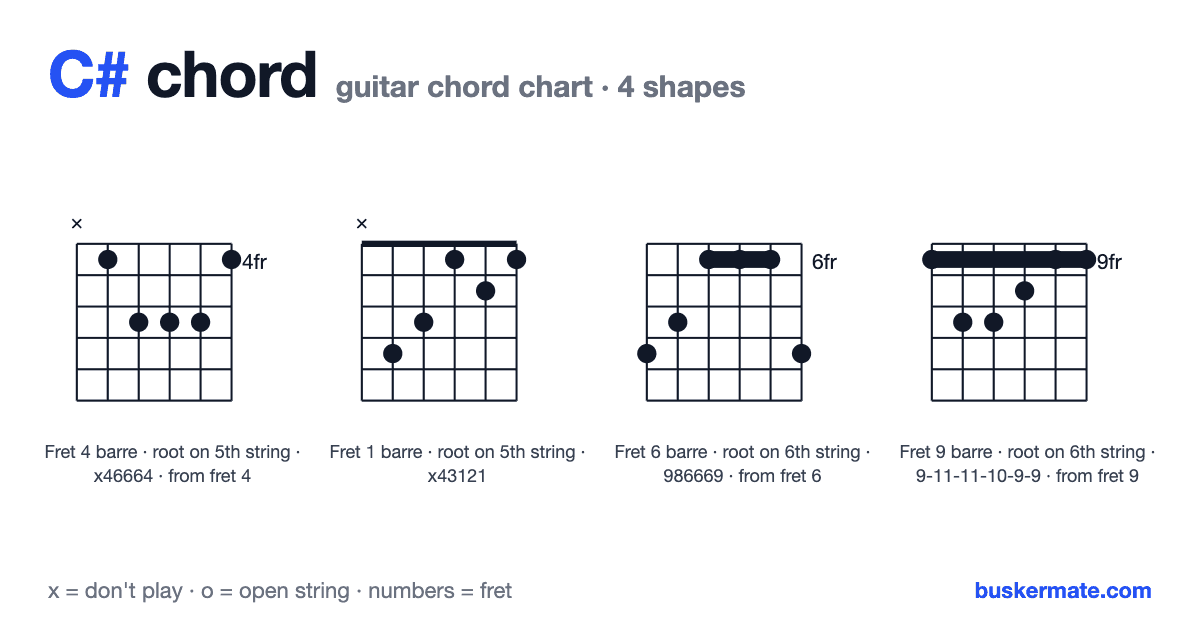
C♯ is a major chord made of C♯ · E♯ · G♯. A major triad — bright and stable, the most basic chord. The standard shape is a barre chord at fret 4: x46664 (6th string → 1st string, x = don't play, 0 = open string).
Chord charts
- Index finger on string 5 (A), fret 4.
- Middle finger on string 1 (e), fret 4.
- Ring finger on string 4 (D), fret 6.
- Pinky finger on string 3 (G), fret 6.
- Pinky finger on string 2 (B), fret 6.
- Don't play string 6 (or mute lightly).
- Strum down from string 5.
Notes in the chord
rootE♯
3rdG♯
5th
Play it easier with a capo
- Capo on fret 1 + C shape → sounds as C♯
- Capo on fret 3 + B♭ shape → sounds as C♯
- Capo on fret 4 + A shape → sounds as C♯
- Capo on fret 6 + G shape → sounds as C♯
If barre chords are hard, clamp a capo and play an open shape — it sounds exactly the same. The Buskermate app can move a whole chord sheet to any capo position for you.
Keys that use this chord
the I chord in Db major · the V chord in F# major · the IV chord in Ab major
Scales that fit
Other C♯ chords
Major chords in other keys
FAQ
What notes are in the C♯ chord?
The C♯ chord is made of C♯, E♯, G♯. A major triad — bright and stable, the most basic chord.
What's the easiest way to play C♯ on guitar?
The standard shape, from the 6th string to the 1st, is x46664 (a barre chord at fret 4). If the barre is hard, put a capo on fret 1 and play a C shape — it sounds the same.
Which scale works for soloing over C♯?
C♯ major or C♯ major pentatonic fits well.
Are C♯ and D♭ the same chord?
Yes. C♯ and D♭ are two names for the same note (enharmonic equivalents), so the fingering and sound are identical — the spelling just depends on the key of the song.
🎸 Transpose a whole chord sheet — Buskermate
Upload a PDF song sheet and Buskermate reads the chords and moves them to any key or capo position (the app is in Korean for now).